Wednesday, 6 April 2016

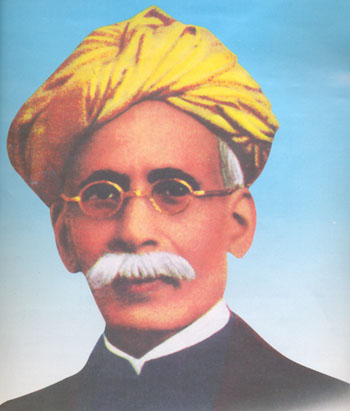
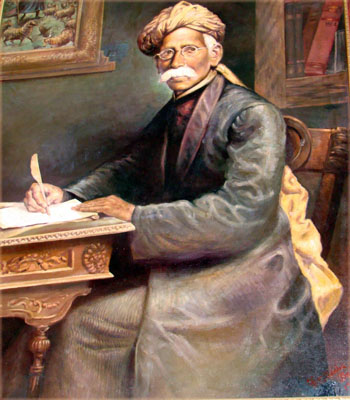
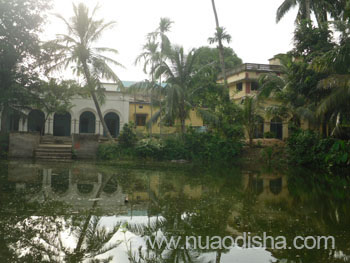
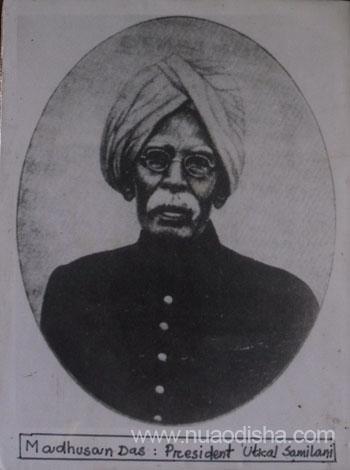
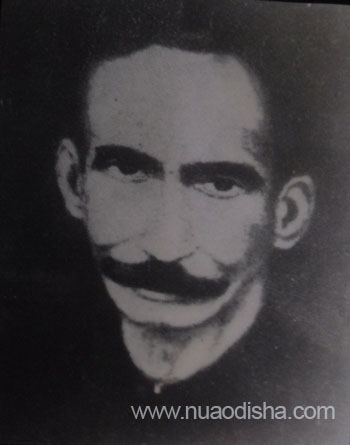
Madhusudan Das

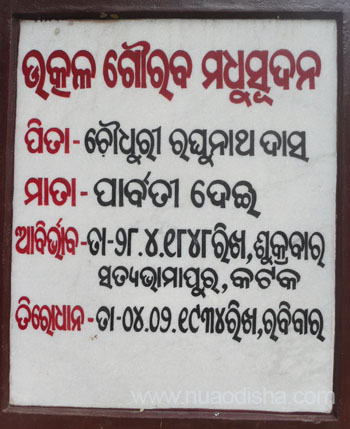
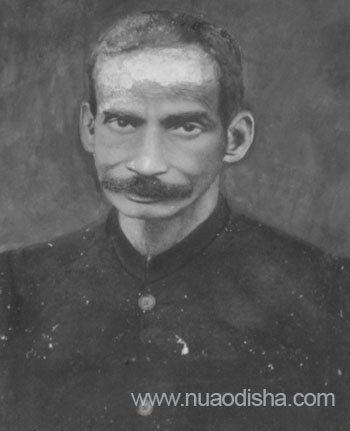
Madhusudan Das was born on 28 April 1848 in the village of Satyabhamapur which is 20 kms away from Cuttack. He took birth in a rich and well to do family of Choudhury Raghunath Das and Parbati Debi. At the time of his birth, his parents named him Gobindaballabh. Later they changed his name to Madhusudan. Now he is popularly known as Utkal Gourav.

Education :
Madhusudan Das had his primary education in the village high school where he learned all subjects, including Persian. After his primary education he went to Cuttack High School and completed his secondary education there. Later he went to Calcutta for fifteen years to pursue his MA and BL degrees. After completing his degrees in MA and BL, he returned to Orissa. He was the first graduate, MA and BL of Orissa.

Contribution towards State and Nation:
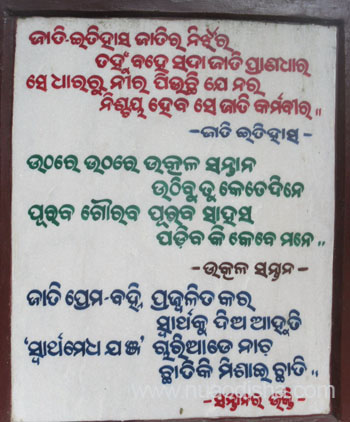
Madhusudan Das worked hard for the social, political and economical uplift of people of Eastern India. He rendered his admirable service to the nation as a very successful lawyer, social reformer and patriot. He was also an excellent orator in Oriya, English and Bengali. He wrote a number of poems and articles in Oriya and English to arouse sense of patriotism in people. He gave away all his earnings generously for the higher education of poor children.

He became a widower at the age of thirty one. Having no family responsibility at that time, Madhusudan Das dedicated himself for the work of nation. He fought against the British rule and started a revolution named “Desha Mishra Andolan”. He took up with the British High Command and the result was the formation of a separate state in 1933.

Last Years :
He was a very generous person and spent his huge property earned from his legal practices in the well being of people of Orissa. Death: Utkal Gouav Madhusudan Das died at the age of 85, on 4th February 1934. By the time of his death, he had spent all his property in the well being of people of Orissa and declared himself insolvent. His immense contribution towards the state and nation would be admired forever.
Sponsored Links

Rani Laxmi Bai

Rani Laxmi Bai

History | 8-14 yrs | Video, Animation

Indian Freedom Fighter

Rani Laxmi Bai, the Rani of Jhansi (November 1835 – 17 June 1858) was the queen of the Maratha-ruled princely state of Jhansi, situated in the northern part of India. She was one of the leading figures of the Indian Rebellion of 1857 and a symbol of resistance to the rule of the British East India Company in the subcontinent.
Her father worked at the Peshwa court of Bithoor and because of his influence at court Laxmi bai had more independence than most women, who were normally restricted to the zenana. She studied self-defence, horsemanship, archery, and even formed her own army out of her female friends at court.
Rani Laxmi Bai was married to Raja Gangadhar Rao Newalkar at the early age of 7 to the Maharaja of Jhansi in 1842, and thus became the queen of Jhansi. After their marriage, she was given the name Laxmi Bai. The Raja was very affectionate towards her.

Jhansi Ki Rani

She gave birth to a son, Damodar Rao, in 1851. However, the child died when he was about four months old. After his death, the Raja and Rani of Jhansi adopted Anand Rao. Anand Rao was the son of Gangadhar Rao’s cousin, and was later renamed Damodar Rao. It is said that the Gangadhar never recovered from his son’s death, and died on 21 November 1853. When the Maharaja died, Rani Laxmi Bai was just eighteen years old, but never lost her courage and took up the responsibility of protecting the interests of Jhansi.
Lord Dalhousie, the Governor-General of India at that time, tried to take advantage of the misfortune of Jhansi to expand the British Empire. The British did not accept Damodar Rao, as the legal heir of Rani Laxmi Bai and her late husband. In March 1854 Rani of Jhansi was granted an annual pension of 60,000 and was ordered to leave the Jhansi fort. She was firm on the decision not to give up the dominion of Jhansi to the British.
For strengthening the defense of Jhansi Rani Laxmi bai assembled an army of rebellions, which also included women. For this great cause she was supported by brave warriors like Gulam Gaus Khan, Dost Khan, Khuda Baksh, Sunder-Mundar, Kashi Bai, Lala Bhau Bakshi, Moti Bai, Deewan Raghunath Singh and Deewan Jawahar Singh. She assembled 14,000 rebels and organized an army for the defence of the city.

Rani Laxmi Bai and Indian Rebellion of 1857

On May 10, 1857 the Indian Rebellion started in Meerut. This began after the rumour that the new bullet casings for the Enfield rifles were coated with pork and beef fat and unrest began to spread throughout India. During this chaotic time, the British were forced to focus their attentions elsewhere, and Rani Laxmi Bai was essentially left to rule Jhansi alone, leading her troops swiftly and efficiently to quell skirmishes initiated by local princes.
Rani Laxmi Bai had always been hesitant about rebelling against the British. Her hesitation eventually came to an end when British troops arrived under Sir Hugh Rose and laid siege to Jhansi on 23 March 1858. An army of 20,000, headed by Tatya Tope, was sent to relieve Jhansi but failed to do so when his forces engaged with the British on 31 March. Three days later the besiegers were able to breach the walls and capture the city. The Rani escaped by night with her son, surrounded by her guards, many of them women.

Death

Along with the young Damodar Rao, Rani Laxmi Bai decamped to Kalpi along with her troops, where she joined other rebel forces, including those of Tatya Tope. The two moved on to Gwalior, where the combined rebel forces defeated the army of the Maharaja of Gwalior and later occupied a strategic fort at Gwalior. However, on 17 June 1858, while battling in full warrior regalia against the 8th (King’s Royal Irish) Hussars in Kotah-ki Serai near the Phool Bagh area of Gwalior, she was killed at battle. The British captured Gwalior three days later. In the British report of the battle, General Sir Hugh Rose commented that the Rani, “remarkable for her beauty, cleverness and perseverance”, had been “the most dangerous of all the rebel leaders.”
Her father, Moropant Tambey, was captured and hanged a few days after the fall of Jhansi. Her adopted son, Damodar Rao, fled with his mother’s aides. Rao was later given a pension by the British Raj and cared for, although he never received his inheritance. Damodar Rao settled down in the city of Indore, and spent most of his life trying to convince the British to restore some of his rights. He and his descendants took on the last name Jhansiwale. He died on 28 May 1906, at the age of 58 years.

Subhas Chandra Bose Biography

Subhash Chandra Bose

History | 8-14 yrs | Animation, Video
Subhash Chandra Bose was born to a Bengali family on January 23, 1897 in Cuttack. His parents were Janakinath Bose who was a well reputed advocate and Prabhavati Devi. He was the ninth child of a total of fourteen siblings.
Subhash Chandra Bose’s nationalistic temperament first came to light at the Presidency College, Calcutta where he studied briefly, when he was rusticated for assaulting Professor Oaten for his anti-India comments in his classroom to all his pupils. Bose later went on to top the matriculation examination of Calcutta province in 1911 and passed his B.A. in 1918 in philosophy from the Scottish Church College.
In 1923, he was elected President of the All India Youth Congress as well as Secretary of Bengal State Congress. He also worked as an editor for Deshbahdhu Das’s newspaper “Forward.” In a roundup of nationalists in 1925, Bose was arrested and sent to prison in Mandalay, where he contracted tuberculosis. After spending two years in prison, Bose was released and was appointed the General Secretary of the Congress party and worked closely with Jawaharlal Nehru for Independence.
During the mid-1930s Bose travelled in Europe, visiting Indian students and European politicians, including Mussolini. He observed party organization and saw communism and fascism in action. By 1938, he had become a leader of national stature and agreed to accept a nomination for Congress president. He stood for Swaraj (self-governance), as well as using force against the British but this however meant a confrontation with Gandhi, which also created a rift between him and Nehru.
On the outbreak of World War II, Subhash Chandra Bose advocated a campaign of mass civil disobedience to protest against Viceroy Lord Linlithgow’s decision to declare war on India’s behalf without consulting the Congress leadership. Bose organized mass protests in Calcutta calling for the ‘Holwell Monument,’ which then stood at the corner of Dalhousie Square, to be removed. Bose was thrown into jail, but was released following a seven-day hunger strike.
Bose’s house in Calcutta was kept under surveillance by the CID. With two court cases pending, he felt the British would not let him leave the country before the end of the war. Subhash Chandra Bose planned an escape with the help of his nephew Sisir K. Bose in a car, dressed as a Pathan sporting a long beard which he grew overnight. This car which he used to escape is displayed at his home in Calcutta.
Subhash Chandra Bose escaped to Germany, via Afghanistan and the Soviet Union. In Germany he founded the Indian Legion consisting of 3000 soldiers out of Indian prisoners of war who had fought for the British in North Africa prior to their capture by Axis forces. Its members swore the following allegiance to Hitler and Bose: “I swear by God this holy oath that I will obey the leader of the German race and state, Adolf Hitler, as the commander of the German armed forces in the fight for India, whose leader is Subhash Chandra Bose.”
Instead of being delighted, Subhash Chandra Bose was worried. An admirer of Russia, Bose was devastated when Hitler’s tanks rolled across the Soviet border. Matters worsened when the now-retreating German army would be in no position to offer him help in driving the British from India. So, in February 1943, Bose turned his back on his legionnaires and slipped secretly away aboard a submarine bound for Japan. Travelling onboard the German submarine U-180 around the Cape of Good Hope he reached Imperial Japan (via Japanese submarine I-29). This was the only civilian transfer between two submarines of two different Navies in World War II.
The idea of a liberation army was revived with the arrival of Subhas Chandra Bose in the Far East in 1943. Bose took control of the Indian National Army (INA) and was able to reorganize the fledgling army and organize massive support among the expatriate Indian population in south-east Asia. At its height the INA consisted of some 85,000 regular troops, including a separate women’s unit headed by Capt. Lakshmi Swaminathan, which was seen as a first of its kind in Asia.
Even when faced with military reverses,Subhash Chandra Bose was able to maintain support for the Azad Hind movement. The INA along with the Japanese fought in key battles against the British Army of India. Spoken as a part of a motivational speech for the Indian National Army at a rally of Indians in Burma on July 4, 1944, Bose’s most famous quote was “Give me blood, and I shall give you freedom!” In this, he urged the people of India to join him in his fight against the British Raj.
The INA’s first commitment was in the Japanese thrust towards Eastern Indian frontiers of Manipur. The INA and the Japanese also took possession of Andaman and Nicobar Islands in 1942 and a year later, the Provisional Government of the INA was established in the Andaman and Nicobar Islands. The islands were renamed Shaheed (Martyr) and Swaraj (Independence). On the Indian mainland, the Indian tricolour, modelled after the Indian National Congress, was raised for the first time in the town of Moirang, in Manipur.
It was the battle of Kohima and Imphal which had a significant impact on the Indian National Army. The Japanese could no longer fund their armies, and eventually surrendered. The INA were no match for the British troops, without the help of the Japanese, and therefore surrendered to the British as well.
Mystery still surrounds the disappearance and eventual death of Subhash Chandra Bose though he is alleged to have died in a place crash in Taipei, Taiwan, on 18 August 1945 while en route to Tokyo. The Imperial Japanese Army Air Force Bomber he was travelling on had engine trouble and when it crashed Bose was badly burned, dying in a local hospital four hours later.
Related Article:
Netaji Subhash Chandra Bose’s Speech for Kids, visit: http://mocomi.com/netaji-subhash-chandra-boses-speech/

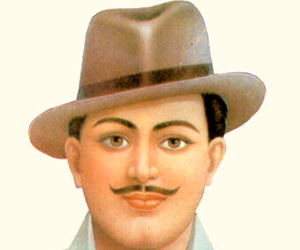
Shaheed Bhagat Singh Biography

Shaheed Bhagat Singh Biography

image: http://www.iloveindia.com/indian-heroes/pics/shaheed-bhagat-singh.jpg
Shaheed Bhagat Singh
Born: September 27, 1907
Martyrdom: March 23, 1931
Achievements: Gave a new direction to revolutionary movement in India, formed 'Naujavan Bharat Sabha' to spread the message of revolution in Punjab, formed 'Hindustan Samajvadi Prajatantra Sangha' along with Chandrasekhar Azad to establish a republic in India, assassinated police official Saunders to avenge the death of Lala Lajpat Rai, dropped bomb in Central Legislative Assembly along with Batukeshwar Dutt.

Bhagat Singh was one of the most prominent faces of Indian freedom struggle. He was a revolutionary ahead of his times. By Revolution he meant that the present order of things, which is based on manifest injustice must change. Bhagat Singh studied the European revolutionary movement and was greatly attracted towards socialism. He realised that the overthrow of British rule should be accompanied by the socialist reconstruction of Indian society and for this political power must be seized by the workers.

Though portrayed as a terrorist by the British, Sardar Bhagat Singh was critical of the individual terrorism which was prevalent among the revolutionary youth of his time and called for mass mobilization. Bhagat Singh gave a new direction to the revolutionary movement in India. He differed from his predecessors on two counts. Firstly, he accepted the logic of atheism and publicly proclaimed it. Secondly, until then revolutionaries had no conception of post-independence society. Their immediate goal was destruction of the British Empire and they had no inclination to work out a political alternative. Bhagat Singh, because of his interest in studying and his keen sense of history gave revolutionary movement a goal beyond the elimination of the British. A clarity of vision and determination of purpose distinguished Bhagat Singh from other leaders of the National Movement. He emerged as the only alternative to Gandhi and the Indian National Congress, especially for the youth.

Bhagat Singh was born in a Sikh family in village Khatkar Kalan in Nawanshahar district of Punjab. The district has now been renamed as Shaheed Bhagat Singh Nagar in his memory. He was the third son of Sardar Kishan Singh and Vidyavati. Bhagat Singh's family was actively involved in freedom struggle. His father Kishan Singh and uncle Ajit Singh were members of Ghadr Party founded in the U.S to oust British rule from India. Family atmosphere had a great effect on the mind of young Bhagat Singh and patriotism flowed in his veins from childhood.

While studying at the local D.A.V. School in Lahore, in 1916, young Bhagat Singh came into contact with some well-known political leaders like Lala Lajpat Rai and Ras Bihari Bose. Punjab was politically very charged in those days. In 1919, when Jalianwala Bagh massacre took place, Bhagat Singh was only 12 years old. The massacre deeply disturbed him. On the next day of massacre Bhagat Singh went to Jalianwala Bagh and collected soil from the spot and kept it as a memento for the rest of his life. The massacre strengthened his resolve to drive British out from India.

In response to Mahatma Gandhi's call for non-cooperation against British rule in 1921, Bhagat Singh left his school and actively participated in the movement. In 1922, when Mahatma Gandhi suspended Non-cooperation movement against violence at Chauri-chaura in Gorakhpur, Bhagat was greatly disappointed. His faith in non violence weakened and he came to the conclusion that armed revolution was the only practical way of winning freedom. To continue his studies, Bhagat Singh joined the National College in Lahore, founded by Lala Lajpat Rai. At this college, which was a centre of revolutionary activities, he came into contact with revolutionaries such as Bhagwati Charan, Sukhdev and others.

To avoid early marriage, Bhagat Singh ran away from home and went to Kanpur. Here, he came into contact with a revolutionary named Ganesh Shankar Vidyarthi, and learnt his first lessons as revolutionary. On hearing that his grandmother was ill, Bhagat Singh returned home. He continued his revolutionary activities from his village. He went to Lahore and formed a union of revolutionaries by name 'Naujavan Bharat Sabha'. He started spreading the message of revolution in Punjab. In 1928 he attended a meeting of revolutionaries in Delhi and came into contact with Chandrasekhar Azad. The two formed 'Hindustan Samajvadi Prajatantra Sangha'. Its aim was to establish a republic in India by means of an armed revolution.

In February 1928, a committee from England, called Simon Commission visited India. The purpose of its visit was to decide how much freedom and responsibility could be given to the people of India. But there was no Indian on the committee. This angered Indians and they decided to boycott Simon Commission. While protesting against Simon Commission in Lahore, Lala Lajpat Rai was brutally Lathicharged and later on succumbed to injuries. Bhagat Singh was determined to avenge Lajpat Rai's death by shooting the British official responsible for the killing, Deputy Inspector General Scott. He shot down Assistant Superintendent Saunders instead, mistaking him for Scott. Bhagat Singh had to flee from Lahore to escape death punishment.

Instead of finding the root cause of discontent of Indians, the British government took to more repressive measures. Under the Defense of India Act, it gave more power to the police to arrest persons to stop processions with suspicious movements and actions. The Act brought in the Central Legislative Assembly was defeated by one vote. Even then it was to be passed in the form of an ordinance in the "interest of the public." Bhagat Singh who was in hiding all this while, volunteered to throw a bomb in the Central Legislative Assembly where the meeting to pass the ordinance was being held. It was a carefully laid out plot, not to cause death or injury but to draw the attention of the government, that the modes of its suppression could no more be tolerated. It was decided that Bhagat Singh and Batukeshwar Dutt would court arrest after throwing the bomb.

On April 8, 1929 Bhagat Singh and Batukeshwar Dutt threw bombs in the Central Assembly Hall while the Assembly was in session. The bombs did not hurt anyone. After throwing the bombs, Bhagat Singh and Batukeshwar Dutt, deliberately courted arrest by refusing to run away from the scene. During his trial, Bhagat Singh refused to employ any defence counsel. In jail, he went on hunger strike to protest the inhuman treatment of fellow-political prisoners by jail authorities. On October 7, 1930 Bhagat Singh, Sukh Dev and Raj Guru were awarded death sentence by a special tribunal. Despite great popular pressure and numerous appeals by political leaders of India, Bhagat Singh and his associates were hanged in the early hours of March 23, 1931.
Read more at http://www.iloveindia.com/indian-heroes/bhagat-singh.html#ducwEwEMJLEiey2k.99

Saheed Baji Rout

Saheed Baji Rout
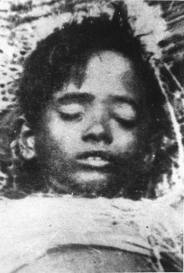
October 11th is an unforgettable day in the history of Odisha. 73 years ago that Baji Rout, a young ferr boy from Nilakanthpur village of Dhenkanal was killed by the British soldiers. The death that shook the nation and added fuel to the ongoing freedom struggle made Baji Rout the youngest Martyr of freedom struggle in India. It was around 8 pm on October 10th in 1938 when British police arbitrarily arrested some people of Bhuban village and took them to the Bhuban Police station .

Protesting against this injustice, leaders of the Prajamandal gheraoed the police station, demanding immediate release of the arrested people. The British police instead opened fire at the agitators that killed two people. However after this incident the British police lost its heart and tried to flee the place. The opted to go to Dhenkanal via Nilkanathpur Ghat it was the shortest route to Dhenkanal.

On the wee hours of October 11th, they reached Nilkanthpur Ghat when it was raining. The thirteen year old Baji Rout was on guard of a country boat at that time. He was ordered by the troop to ferry them across the river Brahamani immediately. Baji who had had already heard details of the brutality of the troop understood that had resorted to villagers and had understood if the British troops were to be obstructed, then they needed to be stopped from going across to the other bank. He therefore refused to ferry them across.

The troop threatened to kill him if he did not ferry them across immediately. Baji however rejected their orders again. One of the British soldiers hit Baji Rout head with his gun butt that fractured his skull severely. He collapsed, but he rose again gathering whatever little strength and courage was left with him, and raising his voice to the highest pitch beyond even his strength, warned the British troops not to ferry them till alive. A soldier pierced his bayonet into the soft skull of the brave boy even as another started firing ruthlessly.

While one of the bullets hit Baji and he lay dead, his other friends Laxman Malik, Fagu Sahoo, Hrushi Pradhan and Nata Malik were also killed. The incident shook the entire nation. People from within and outside the state lauded the supreme sacrifice of the barve martyr. The funeral procession of Sahid Baji Rout started from his native village of Nilakanthpur to Khan Nagar in Cuttack. It’s a shame that 73 years on the youngest martyr of Indiahas not received due recognition from the Government of India. Though he is mentioned in the who’s who of Indian Martyrs being published by the government ofIndia, this young martyr definitely deserves more.

LAXMAN NAYAK

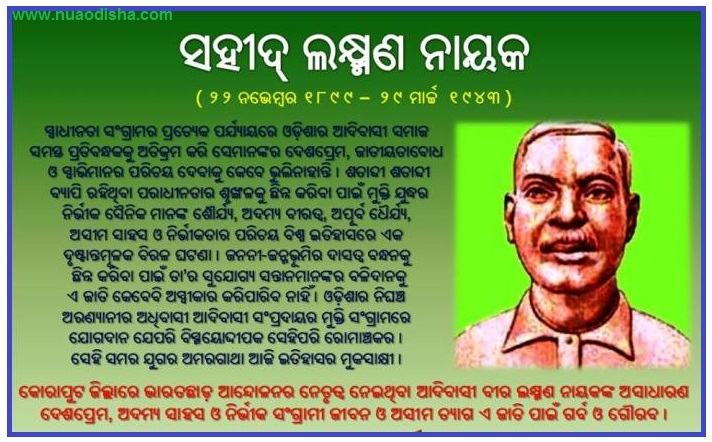
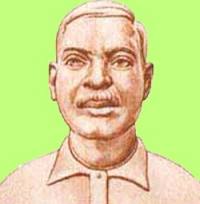
Saheed Laxman Nayak
Tribal resistance movement was an integral part of freedom struggle and the heroic role played by many distinguished tribal leaders. They had identified themselves with the mainstream freedom struggle against heavy odds and at the cost of their lives and princely career. Laxman Naik of Koraput is one of them. There is a long and illustrious list of tribal resistance movement took place in different parts of Orissa. But nothing could be more inspiring and edifying than the saga of heroic struggle and sacrifice of one single tribal leader of Koraput whose feats and exploits till today are unparallel.

This great man is no other than Laxman Naik of Koraput District. Laxman Naik was born on 22nd November, 1899 in Tentuligumma of Malkangiri. His father was Padlam Naik. He belonged to a Bhuyan tribe. He fought single handed against the oppressive foreign rulers with consummate skill and a rare passion and fervour of a fighter. He was the very fountain of grit, courage and strength to countless followers and co-workers and shone by rare brilliance. He stood up like a rock with only one supreme truth as his polestar, the freedom of his mother land.

He sacrificed all his creature comforts and ultimately consumed himself but did not break or bend a bit before the wily machination of the foreign usurpers. This innocent tribal hero Laxman Naik was attracted towards the National Movement, when the message of Congress Movement reached Koraput. He became an active member of the Congress in enrolling as charanna member of the Indian Natinal Congress. He received all kinds of physical education and learnt about national integration. He organized the tribal people to fight against old and inhuman practices like bonded labour. He played a key role to popularize Congress programme in Koraput.

The tribal people of Koraput and its surrounding like Malkanagiri, Tentulipada accepted him as their hero and devoted themselves for the cause of national freedom. He promoted ‘Khadi’ and made people aware of the Congress plan of action. He tried to inculcate a sense of unity among people for the freedom. The subaltern perception of people’s participation found its subtle manifestation in this part who fought for freedom. It was more insistent in case of the illiterate villagers than that of the elitists of town. The mass participation of tribals in this area took a new dimension in the Congress movement after congress formed ministry in 1937. They get a sense of fresh courage which led to some minor incident of rioting.

The best example is killing of a sub-inspector with an axe when he removed a Congress flag while hoisting. Violence in a nonviolent movement like Indian National Movement could be seen from such incidents. Laxman Naik took the charge of President of the Congress primary committee at Matili in Koraput in 1942. He managed to mobilise the tribal people for various development works like construction of roads, building bridges and establishing schools. He asked the villagers not to pay any tax. He spearheaded the fight against oppression, sufferings and exploitation. During the Quit India Movement 1942, Laxman Naik was nominated to represent Matili. He used nonviolence as a main weapon against colonial power. The tribal people called him “Gandhi of Malkangiri. The tribal movement created an unprecedented public awakening in Koraput.

The message of Quit India Movement was circulated in the whole of Koraput. The Bonda tribes of this region were violent and belligerent and seized Matili police station under the leadership of Laxman Naik. In 1942, August, Laxman Naik and Congress workers attacked liquor shop at Kongrabeda, Muntipalli, Sindhabeda. He led a long procession to Matili police station. It was on August 21, 1942, tribals from different villages moved towards matili, holding a Congress flag and chanted ‘Ramdhun’ and proceeded towards police station. They entered the compound of police station and tried to hoist the flag at the top of the Police Station. Laxman Naik was not allowed to hoist flag, as the magistrate Mujibur Rahman ordered ‘Lathi’ charge on the demonstrators. The angry demonstrators gave patriotic slogans. Two police officials Ram Murty and constable Mohanty were injured.

As the police opened firing, 5 died on spot and 17 injured. The injured Laxman was thrown into the ditch near the compound. It was a blessing in disguise for the police to involve Laxman in a murder case of forest guard G. Rammaya. He along with his son and other Congress workers were arrested at Matili police station and were sent to Koraput jail. The trial of Laxman Naik was made at the Additional session court of Koraput. V.Ramnathan, the Additional Session judge, Koraput sentenced Laxman Naik to death under section 302 of IPS. He was then sent to Berhampur Jail for execution.

Laxman Naik was in the cell since November 16,1942. When his execution date drew nearer, he wished to see his fellow prisoners and eat what they were given. All the inmates of Berhampur jail offered prayer. His fellow prisoners wept throughout night of March 28,1943. At the break of dawn on March 29, 1943 by 5.30 a.m., Laxman Naik gallantly marched towards the Gallows. He wished his last. ”If the sun is true, and so is the moon, it is then equally true that mother India shall be independent.” Rammurty, the Zamadar of jail pulled the lever bringing the iron plate under his feet down. There ended his life, and he was buried inside the jail compound. Though Laxman Naik did not live to see free India, he remained imprinted in the minds of millions of people of India as the leader of leaders.